- IOS List
- Posts
- Market Deep Dive: Jacksonville, FL
Market Deep Dive: Jacksonville, FL
The metro’s geography is its competitive advantage: Jacksonville sits at the intersection of I-10 and I-95, tying West Coast freight flows to East Coast population centers.

Justin W
December 06, 2025
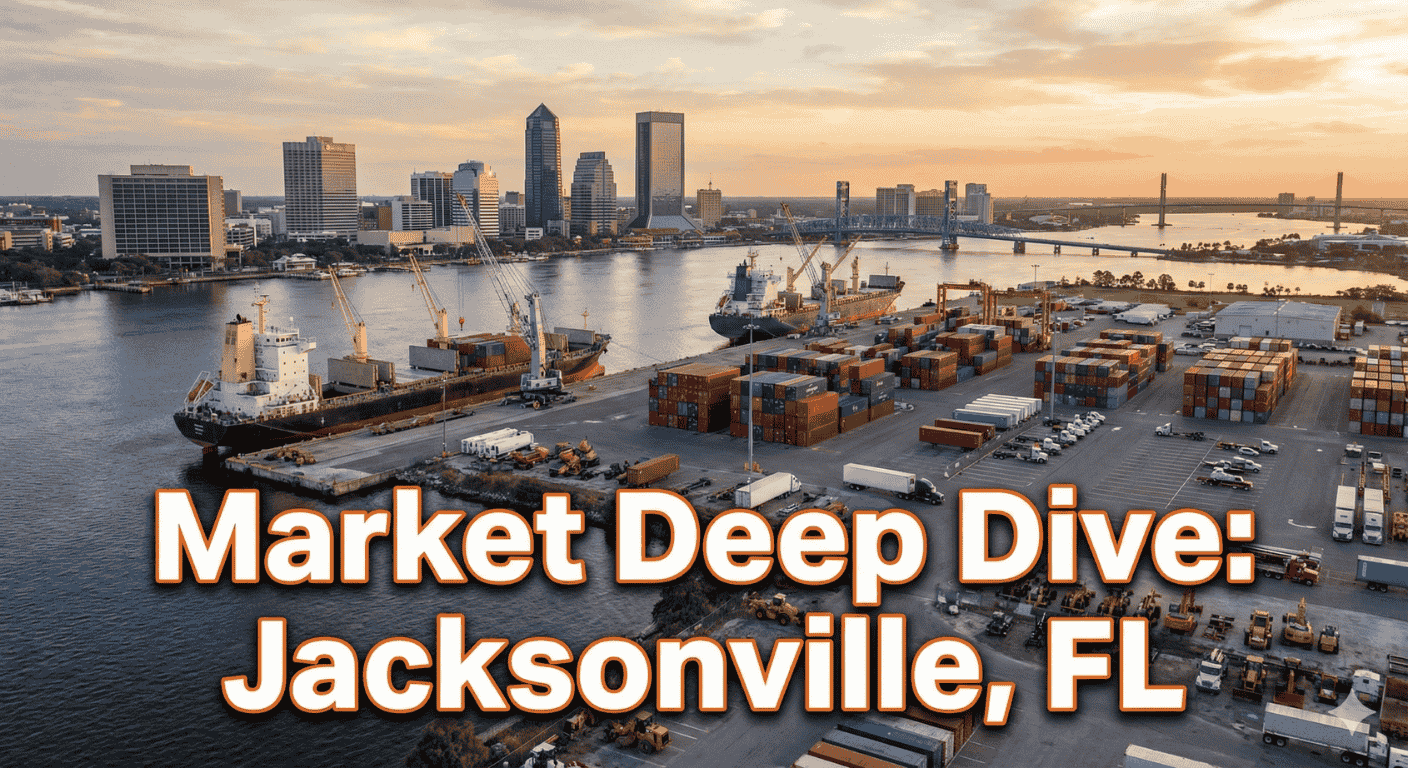
Market Deep Dive: Jacksonville, FL
A Deep-Dive Into One of the Southeast’s Most Scalable IOS Markets
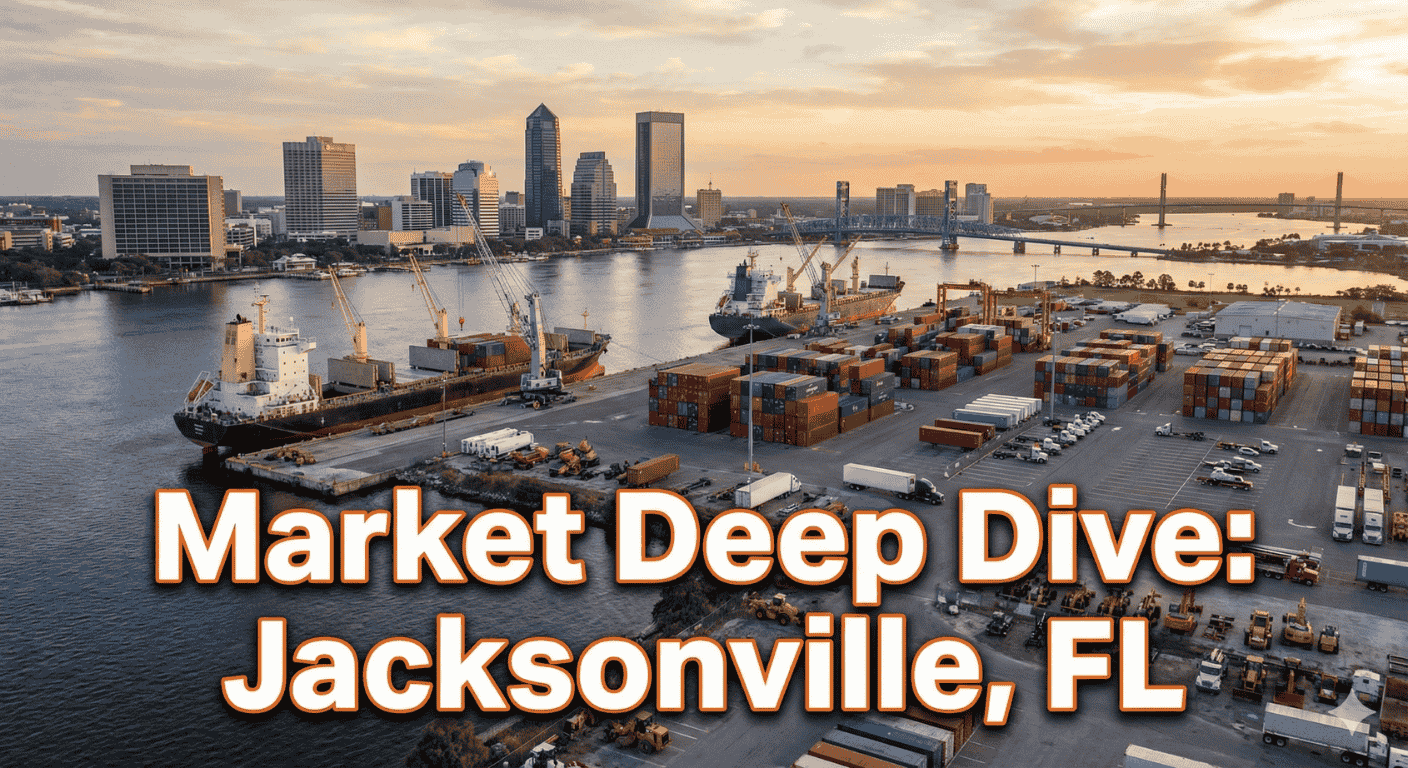

Market Overview
Jacksonville continues to be one of the country’s fastest-expanding major metros. Over the past decade, the population has climbed roughly 23%, and projections call for another 11% increase by 2028. That growth is paired with rising household incomes, a diversified economic base, and steady in-migration from both Florida and the broader Southeast.
Industrial fundamentals remain compelling. As of Q3 2024, vacancy is holding in the mid-4% range, supported by demand from port users, construction logistics, e-commerce, and regional distributors. The metro’s geography is its competitive advantage: Jacksonville sits at the intersection of I-10 and I-95, tying West Coast freight flows to East Coast population centers and giving the region a natural role in long-haul trucking and multimodal distribution.
The Northeast Florida logistics ecosystem is unusually complete compared to peer markets — with deep-water marine access, Class I rail connectivity (CSX, Norfolk Southern, Florida East Coast Railway), an expanding airport cargo presence, and interstate networks that make cross-country freight movement efficient.
JAXPORT continues to anchor the region’s industrial identity. As Florida’s top container port complex — and one of only 17 U.S. ports authorized for military cargo — it draws import-export operators, 3PLs, automotive processors, and drayage fleets. The benefits of Foreign Trade Zone 64 create additional pull for users seeking duty and tariff efficiencies. Industrial activity clusters around the port, throughout the I-295 loop, and westward along I-10 — all areas where IOS demand is strongest.
The IOS Opportunity
IOS has become a core part of Jacksonville’s industrial stack. Population gains, rising construction volumes, and port throughput have created consistent demand for both small urban yards and large multi-acre sites serving transportation and equipment-heavy operators.
Leasing data from 2022–2025 shows IOS rents averaging around $4,000 per acre per month, with annualized rent growth in the 6–10% range. Land pricing typically runs $600K–$800K per acre, with premium pricing along the I-10 Westside corridor where logistics users cluster.
Trucking and logistics groups account for the majority of IOS leasing activity. Between 2023 and 2025, nearly 60% of observed IOS leases came from this category, with users often taking 8–9+ acre sites at average rents around $3,900 per acre per month. Commercial services users — contractors, equipment rental, building supply — represent the next largest cohort, generally preferring 2–4 acre yards and paying a slight premium at $4K–$5K per acre.
Local brokers report increasing demand for 3–5 acre improved yards with service shops, utilities, stabilized base, security lighting, and gated access — especially from national credit tenants needing 1–2+ year commitments. Traditional unimproved yards continue to trade around $3,650 per acre per month, while improved sites hold materially stronger pricing due to limited inventory.
Market Fundamentals
Jacksonville offers a rare combination in the IOS world:
Depth of supply: Hundreds of viable IOS sites across the metro — unusual for a high-growth market.
Multimodal infrastructure: Maritime + rail + interstate + air freight, all reinforcing each other.
Cost advantages: Land and occupancy costs remain below competing Southeast metros.
Port-driven demand: JAXPORT expansion and FTZ-64 advantages amplify long-term IOS usage.
Site types vary widely: everything from compact infill yards near Downtown and Riverside to expansive 10–20+ acre logistics sites along I-10 and I-295. Many yards are fenced and lit, while institutional-grade assets include shop buildings, wash bays, utilities, and heavy truck circulation.
Land-use pressure is still modest compared to markets like South Florida or Southern California, but competition is tightening around JAXPORT, the I-10 corridor, and key intermodal nodes as logistics users expand.
The Bottom Line
Jacksonville checks every box for IOS investment and operational scale:
population growth, multimodal freight access, port-driven demand, rising rents, and a meaningful pipeline of viable sites.
Users increasingly view yard space as mission-critical logistics infrastructure — not an optional extension of warehouse capacity. With transaction activity picking up, investor interest accelerating, and room for long-term expansion, Jacksonville stands out as one of the most investable IOS markets in the Southeast.

THE BROKERS YOU NEED TO KNOW
Matthews
 | Mike Salik |
Colliers
 | Eric Bumgarner |
 | Michael Cassidy |
 | Gordon Olson |
Franklin Street
 | Shaun Mayberry |
 | Cooper Folds |

→ Try our resources for IOS pros: