- IOS List
- Posts
- Market Deep Dive: Salt Lake City
Market Deep Dive: Salt Lake City
Supply remains constrained, particularly for infill yards that can support immediate operations.

Justin W
March 11, 2026

IOS Market Deep Dive: Salt Lake City, Utah
Supply remains constrained, particularly for infill yards that can support immediate operations. Many municipalities along the Wasatch Front apply strict zoning rules to outdoor storage uses, and new projects often face longer approval timelines, higher development costs, and additional site requirements. These factors limit the pipeline of new IOS inventory and increase the value of existing properties.

TLDR
Strong regional logistics hub: Salt Lake City benefits from its position at the crossroads of the Mountain West, with excellent interstate, rail, and air connectivity supporting steady IOS demand.
Lease rates: Most recent deals fall between $3K–$10K per acre per month, averaging around $5K–$6K/acre/month.
Sale prices: Typically $700K–$1.5M per acre, with averages near $1.3M per usable acre.
Supply constraints: Limited flat infill land along the Wasatch Front and increasing zoning scrutiny continue to restrict new IOS development.
Key drivers: Construction, building materials, fleet services, equipment rental, and regional distribution users.
Outlook: Long-term fundamentals remain strong as population growth and land constraints increase competition for functional yard sites.
Market Overview
Salt Lake City continues to benefit from strong population growth, above-average job formation, and its role as one of the primary logistics and service hubs in the Mountain West. Demand for industrial and outdoor storage space remains durable across the Wasatch Front, supported by construction activity, building materials distribution, fleet services, and regional operators serving Utah, Idaho, Wyoming, Nevada, and parts of Colorado.
The region’s strategic importance is rooted in its infrastructure. Salt Lake City sits at the intersection of I-15, I-80, and I-84, giving operators efficient north-south and east-west access across the western United States. Utah’s highway network allows companies to reach tens of millions of consumers within a day’s drive, making the metro an attractive base for regional distribution and service operations. Rail connectivity through Union Pacific and BNSF, along with proximity to Salt Lake City International Airport, further strengthens the market’s logistics advantages.
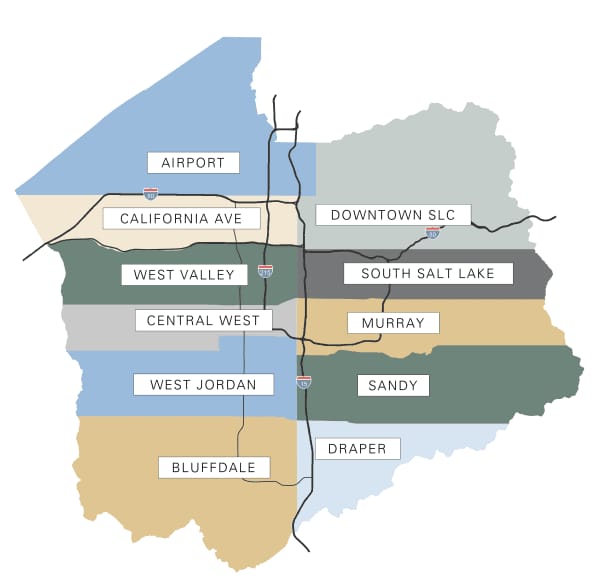
SLC Submarkets via Newmark
Recent industrial performance continues to support IOS demand. While leasing activity has moderated from peak levels, absorption in non-bulk and specialized industrial product remains healthy, and vacancy for smaller, functional properties stays well below national averages. This trend reinforces the resilience of infill, service-oriented, and yard-intensive assets compared to large distribution buildings.
As the Wasatch Front continues to grow, competition for well-located industrial land is increasing. Development pressure, limited flat sites near major corridors, and entitlement challenges across multiple municipalities are making it harder to deliver new outdoor storage product. These conditions favor existing IOS sites with strong access, proper zoning, and efficient layouts.
Rent trends also show divergence between product types. Bulk warehouse rents have softened in some submarkets due to increased concessions, but flex, incubator, and yard-oriented properties continue to see steady pricing, supported by demand from smaller operators that require functional space rather than large distribution buildings.

The IOS Opportunity
The Salt Lake City IOS market experienced consistent tenant and buyer demand throughout 2025, driven by limited availability of functional outdoor storage sites and steady industrial activity across the Wasatch Front.
Recent leases typically range from $3K to $10K per acre per month, with most transactions clustering around $5K to $6K per acre per month, depending on location, improvements, and zoning.
Sale prices over the past two years have generally fallen between $700K and $1.5M per acre, with an average near $1.3M per usable acre for well-located sites with industrial zoning and good interstate access.
Supply remains constrained, particularly for infill yards that can support immediate operations. Many municipalities along the Wasatch Front apply strict zoning rules to outdoor storage uses, and new projects often face longer approval timelines, higher development costs, and additional site requirements. These factors limit the pipeline of new IOS inventory and increase the value of existing properties.
Tenant demand continues to come from construction companies, utilities, equipment rental groups, building-materials suppliers, and fleet-based service operators. These users prioritize access to major corridors such as I-15, I-80, and SR-201, as well as proximity to population centers along the Wasatch Front.
Over the long term, fundamentals remain favorable. Population growth, strong employment trends, and limited developable land all point to continued competition for functional IOS sites, especially in established submarkets.
IOS Market Fundamentals
Salt Lake City’s industrial ecosystem is supported by a combination of population growth, manufacturing, construction, and regional distribution activity. The metro’s connectivity to major highways, rail networks, and the airport allows businesses to efficiently serve both local markets and the broader Mountain West.
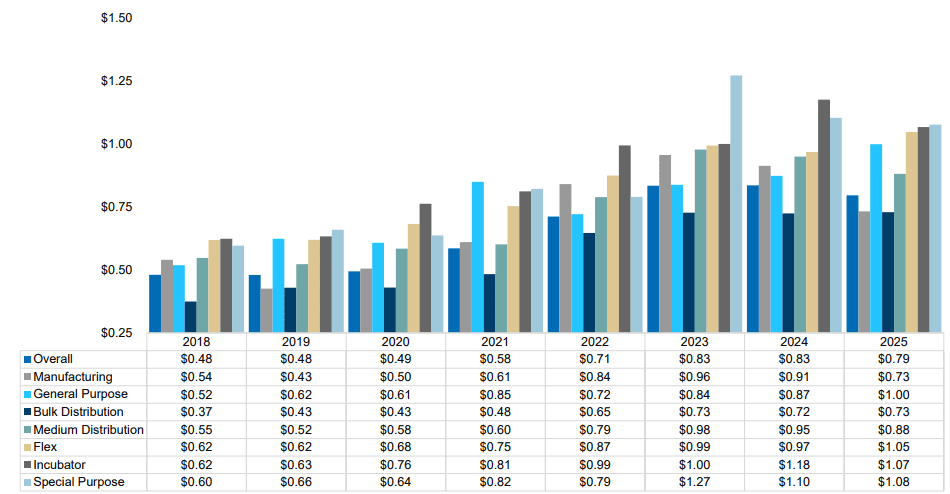
Source: Newmark
New industrial construction has occurred primarily in outlying submarkets where land is more available, but these areas do not always provide the access or zoning needed for outdoor storage users. As a result, vacancy for infill, yard-oriented properties remains tight, particularly near established interstate corridors.
Zoning and topography continue to shape the market. Much of the Wasatch Front is constrained by mountains, lakes, and existing development, leaving limited flat land suitable for industrial use. Municipal regulations on outdoor storage, screening, paving, and traffic access further restrict supply, making fully entitled IOS sites difficult to replace.
As these constraints persist, competition for well-located sites is expected to increase, reinforcing pricing strength for properties with clear zoning, strong visibility, and efficient circulation.
Salt Lake City - IOS Pros to Know
Broker | Firm | |
|---|---|---|
Eli Priest | Newmark | |
Lucas Burbank | Newmark | |
Kelsi Akiyama | Newmark | |
Canyon Czapla | Newmark |
→ Try our resources for IOS pros: